

MIT course
DNA Replication | MIT 7.01SC Fundamentals of Biology
Eric Lander
MITOCW | MIT7_01SCF11_track07_300k.mp4
2011 MIT lecture on DNA replication, at around the minute mark 19:40 Dr Lander said that the topoisomerase does an amazing job
So it turns out there is an enzyme that just gets in there and makes a double
stranded cut in one of the double helices, grabs the two ends, passes it around the
other side, and ligates them back together, and keeps doing that until they’re
disentangled. Pretty clever. Cut, paste, cut, paste till it can separate those two
double helices from each other. Remarkably, this enzyme is called topoisomerase.
This job is done by topoisomerase, actually, by topoisomerase II. There’s a couple
of different topoisomerases, and it’s topoisomerase II that does this particular job,
cuts and seals up that double-stranded break.
All right. It is amazing how this works.
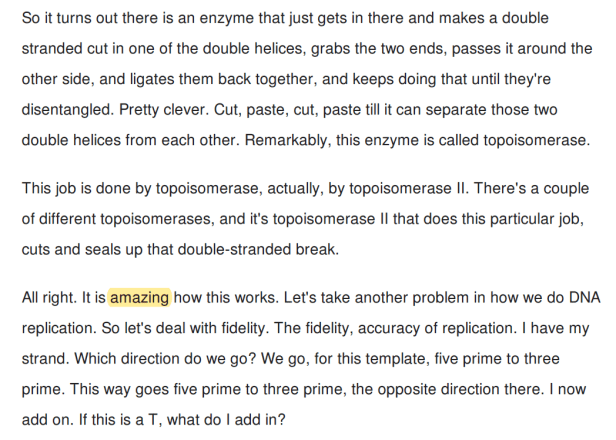
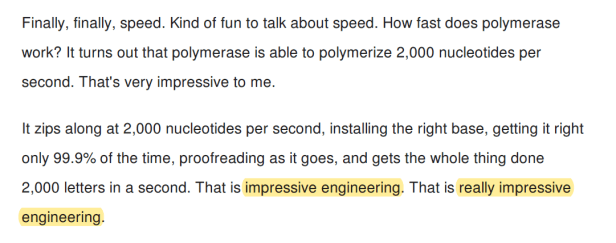
starting at time mark 28:25 approximately Dr Lander qualified it as “really impressive engineering”
Finally, finally, speed. Kind of fun to talk about speed. How fast does polymerase
work? It turns out that polymerase is able to polymerize 2,000 nucleotides per
second. That’s very impressive to me.
It zips along at 2,000 nucleotides per second, installing the right base, getting it right
only 99.9% of the time, proofreading as it goes, and gets the whole thing done
2,000 letters in a second. That is impressive engineering. That is really impressive
engineering.
 Common Design